Saturday, 30 March 2013

AFK for Nine Weeks

So I've been AFK since January which means I've not updated my blog and I've barely been pinning.  In fact, I've barely seen many of my real life friends for that matter.  Well, that stops now.  Of course, I do have a very good reason at least...

I make stuff.  Specifically, one of the things I do is make kit for live action roleplay (LARP or LRP), historical re-enactment and sometimes, just purses and handbags.  The last eight weeks have been fraught; this is the start of LARP season, the start of re-enactment season... and people have recovered from Christmas.  So.  Without further ado...

What I made in the last week of January:

Ladies Hero Belt:  Celtic and shaped for us girls with hips.  Makes a huge difference to comfort.

Monogrammed Kindle Cover:  Proof I don't just make costume!

What I made in February:

Dwarf kit:  Beaver-hide shoulders, oil-tanned leather harness, hero belt and leather tabard.  
Yes, I may have loosely based the shoulders, belt and harness from kit seen in The Hobbit.  The intended look is "inspired by" not "derivative".

I also made a hero belt, a set of bracers and a set of armlets during this time.  Sadly, as these were very close to the deadline, I only have work in progress shots of the bracers and armlets.  I'm hoping to get pictures of the finished products soon:

Boar design for bracers, before dyeing.

One of the armlets, just after dyeing but before putting on the finishing touches.

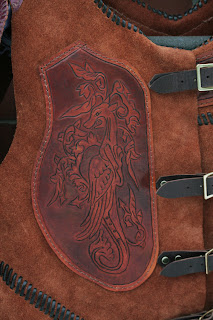
 I also started making some decorative patches for a jerkin:

For the back, across the shoulders. 

Down the right side of the chest

A little bit of detailing on the collar.  

Although I finished the jerkin in March, probably just best to put it up here now...

Sadly, the mannequin I used was at another maker's house -- and the customer is way smaller than I am, so this shot will have to suffice.

And finally... FINALLY...

What I made in March (everything ever, by the feel of it):

March was full of armour, armour, armour, more armour and... a handpurse.


A small monogrammed hand purse.  Vegtan, suede pigskin lining.
A circlet, belt and pauldron set, tricked out in brass.  3.5mm - 4mm vegtan.  That stuff was wonderfully gnarly to work with.  The brass cut aways are runes as this is supposed to represent magical armour.

Two shots of my most favourite bracers I've ever made, ever.  I may have to make a set for myself next time!

I also created a hooded mantle to go with a set of armour.  It has detailed bits, which are super hard to get pictures of whilst being worn across the shoulders, so here's a shot of one below:


Followed by a shot of the mantle and the jerkin it goes with being modeled by the very understanding other half, as it's tailored for a bloke.  However, I wanted pictures of me in the mantle too, so we took some:


Yeah, okay, that last one is just included because I liked how it looked.  Hey, how often do you get to go on a make binge, make some awesome stuff, and then take pictures of it in the snow, in which everything looks better?  

The final make list for the last nine weeks:
Kindle cover
Four hero belts
Two sets of bracers
A pair of armlets
A hooded mantle with decorative gubbins
Two jerkins, one highly decorative
A runic headband
One set of pauldrons
A mini-clutch purse
A beaver skin shoulder set
A harness
And a leather tunic.

Oh, and the 20 group symbols (not pictured) created using emboss plates.  Because emboss plates are awesome -- after all, I can create a design in Photoshop or Illustrator and *bosh* the job is done.

I work in a "real job" two days a week and volunteer elsewhere a day a week.  On reflection, no wonder it's been tough.  I have actually put my foot down and am taking a week off though.  Aside from that scabbard I'm going to make.  And maybe a handbag... *grin*.  I think I hear my other half putting his foot down...


Follow Me on Pinterest

Saturday, 19 January 2013

Medieval Glasses and Viking Reading Crystals

As a leatherworker, I get extremely interested when I hear the phase "leather framed glasses".  I never knew such a thing existed until a few days ago, when I saw a link to an article discussing a rare book containing an even rarer imprint of glasses.  Yes, someone, several hundred years ago, shut their glasses in the back of a book they'd been reading:

 Impression of glasses left in the endpapers of a copy of the Opera of Fr. Luigi di Granata (1568-69).  This copy uses a page from an older manuscript.  It was pretty common for printed books of this time period to reuse old manuscripts for endpapers or as spine liners.  Photo by Pete Smith.  Original article:  http://www.utexas.edu/opa/blogs/culturalcompass/2012/04/17/medieval-spectacles/

The speculation is that these were leather framed glasses, an invention that was certainly in use in the 15th and 16th centuries.  It certainly makes you wonder how long those glasses remained in there before someone removed them though.  I also wonder how unobservant someone would have to be to lose their glasses in such a way...

Still, glasses are definitely up there in the most important inventions of the last 2000 years.  They were likely invented in Italy between 1268-1289, based on contemporary sources such as paintings and even sermons.  Although none of these early spectacles have survived (the earliest pair we have being from around 1400), we know that The Guild of Crystal Workers in Venice adopted the term "roida da ogli" in 1300 to refer specifically to lenses for glasses.

Before glasses were developed, however, monks had been using reading stones.  These were basically medieval magnifying glasses:

Between 1000 and 1250, presbyopic monks used reading stones, often made of beryllium or quartz, to read and work on manuscripts.  It would take another two centuries before someone thought to stick smaller versions of them into frames that sat in front of the eyes.

It was thought that these reading stones were mostly the property of monks, however, a set of crystal lenses made from quartz showed up in Viking graves in Visby, Gotland (Sweden).  Now, in fairness, Vikings were known for their love of pillaging monasteries.  They also had trade links though, which we often forget about.  Archaeologists believe that the lenses came from Byzantium or the Middle East, although unfinished lenses and rock crystal beads were found in 1999 in Frojel, meaning that someone could have been making them on Gotland.  The nifty thing about these lenses is that these people didn't have the mathematical knowledge to create them, still believing that light emanated from the eyes, rather than entering them.  They must have created these things through trial and error alone -- and it's believed that the know-how to do so was restricted to only a handful of craftsmen, if not only one at this time.

A range of the lenses found at Visby, although sadly, the largest and most impressive one has been lost since the 1950s.  Some of these were mounted and hung from pendants.  The others may have been waiting for mounting or were left deliberately unmounted.  Likely used for magnification, however, they could also have been used for starting fires or just as decoration.

Work undertaken at Aalen University of Applied Sciences concluded that although the mounted lenses were most likely used only as jewelry, the larger, unmounted lenses are shaped just like a modern projector lens.  The shaping was also deliberate, not accidental, so it's very difficult for the scholars to believe that these items weren't intended  to work as visual aids.  Certainly not during a time when such items did not commonly exist.

Refractive bling:  An aspheric lens mounted in silver, found in the graves in Visby, Gotland.  The lenses are suspected to be older than their mountings.  On the decorative pendants, like this one, the back of the mount is not open, but polished silver.  This smaller lens is purely decorative.

Either way, there's no disputing that if I were a Viking with a sight problem living on Gotland, I'd want one of these bad boys to help me see to do my crafts.  Also, it must be said that the smaller mounted lenses are really very pretty.  I'm a sucker for Viking bling, what can I say?


Follow Me on Pinterest


Friday, 11 January 2013

Forbidden Books: Aristotle's Complete Master-Piece

If a book is considered too racy and controversial to be socially acceptable, demand for it will be high.  Of course, there will always be people who tut and sigh, even if the book is designed to be a medical and biological guide intended to inform rather than entertain.  This is the case with Aristotle's Complete Master-Piece, which was first printed in 1680 and became a "banned" book in Great Britain until the 1960s.  In the 18th century, however, more copies of this book sold than for any other medical manual on the market.

Interestingly, the book wasn't written by Aristotle and nor did it draw upon his works; it's thought that the name was used to sell more books through the credence of the name.  It also, strictly speaking, wasn't officially and legally banned, according to Lyon & Turnbull, contradicting earlier news stories about this book.  Sure, it was a work of high taboo and no one wanted to put their printing house on the copies, possibly for fear of persecution or even loss of earnings through association.  Granted, it wasn't a polite book that people admitted to owning or wanted to be caught with.  And yes, no one really wanted to be caught selling it either, but with that many sales, well, you can well imagine the conversation:

"Excuse me, but do you happen to have a copy of, ahem, that book, you know the one, about... women's bits... for sale, perhaps under the counter somewhere...?  I'm a mid-wife/doctor.  I'm only asking for necessity, you understand.  For my job."  "Of course you are..."

Forbidden Book for Auction:  Aristotle's Master-Piece Improved.  "Printed and Sold by the Booksellers" because no one wanted to accept responsibility for printing a medical and sexual manual in the 17th and 18th centuries.  Chapters split into Marriages, Monsters, Conception and Directions for Midwives.

The book actually calls on the earlier works of Nicholas Culpepper and Albertus Magnus, with a very liberal helping of old wives tale.  For example, did you know the best way for a midwife to help a woman with the afterbirth was for her to burn marigolds and generally waft the smoke into the mother's birth canal?  Yeah, there's a reason why you didn't know that.  Not really all that helpful after all, but in 1766, when the book above was published, this was stellar advice.  I have never been so glad for modern medicine.

The book also advises on conception, advising that women and men both should enjoy the act of sex in order to conceive.  This advice being given in the 18th century seems odd to us looking back on it from the modern day, but remember that we're looking back on history as filtered through the straight-laced Victorian era, which is ironic, given Victoria's own exploits.  The book also shows a picture of a baby in the womb, in context of the female body, which would have been quite helpful to midwives -- in theory at least:

Banned imagery -- "The Figure Explain'd:  Being a dissection of the womb with the usual manner how the child lies therein, near the time of its birth."  Being the most explicit picture in this book, it was likely the reason it was banned.

One of the odder chapters is about "monsters and monstrous births and the several reasons thereof".  Of course, it wouldn't be a good medical manual without illustrations of the "monsters" (a word that by today's standards is possibly the only thing still shocking in this book):

Illustrations from the 1766 edition of the banned book Aristotle's Complete Master-Piece Improved of "monsters" -- the only idea presented in this book that is still shocking outside of some of the dodgy medical advice.  It attempts to provide case studies and give advice on how to avoid birth defects.

Much of the advice revolves around the archaic idea of a child that is conceived through sin will suffer such defects as being covered in hair, being conjoined, missing limbs or even having a mouth in the chest or stomach.  "Sin" is often referred to as being extra-marital affairs or the child being conceived outside of wedlock. 

The book is certainly a strange one and I have to admit that I wouldn't mind spending an afternoon reading it.  However, in order to do that, I'd need to participate in the auction on 16th of January, and have approximately £300 ($500ish) to hand.  I may need £300...


Follow Me on Pinterest


Thursday, 10 January 2013

Gruesome: Blood of Decapitated King Found in Gourd

People like trophies of their victories; of course, that depends on the context of the victory.  When the victory is the execution of a king, trophies of blood appear to be the order of the day -- at least, in 1793 in revolutionary France (or if your name happens to be Tamyris).

It's always been rumoured that the people present at the execution of Louis XVI dipped their handkerchiefs in the blood that spilled from the neck of the dead king.  Now, thanks to DNA analysis, that claim has been proven in a report published last month in the journal Forensic Science International.

One of these handkerchiefs was stored in a dried gourd, made for the purpose.  Over time, the handkerchief deteriorated, however, the blood remained dried on the inside of the gourd:

 Gourd containing the dried blood of the executed King Louis XVI of France.  The inscription reads "On January 21, Maximilien Bourdaloue dipped his handkerchief in the blood of Louis XVI after his decapitation."  Via Livescience.

The gourd has been held by a wealthy Italian family for a number of years and until now, there has been no real way of proving the inscription.  This is mostly because the French royal family had a bit of a hard time of it (to say the least) during the French Revolution, even the dead ones.  The royal family was so hated that revolutionaries actually went to the cemetery at Saint-Denis, took the long-dead bodies of the royals from their tombs, mutilated the corpses and tossed the remains into pits.  In 2010, however, a head from one of these mutilated corpses surfaced and was made available to the scientific community for DNA testing.  It was said to be the head of this man, Good King Henry:

 Before death and desecration:  Henry IV of France -- Good King Henry rose to the throne in 1589 when his cousin, Henry III of France, was assassinated by a fanatical Catholic monk.

Good King Henry was actually considered to be a pretty awesome ruler, as rulers go, trying to improve the lives of all his subjects and quoted as saying things like "If God keeps me, I will make sure that there is no sharecropper in my kingdom who does not have the means to have a chicken in the pot every Sunday!"  However, given the anger of the revolutionaries, and the fact that his reign ended in 1610 -- and that the revolution took place in the 1790s...  It's hardly surprising, really, that they revolutionaries desecrated the graves, even if it is really very grim.  And it is really very grim.  Check it out:

 After death and desecration:  The head of King Henry IV of France, found in the garage of a French pensioner in 2010.  You can actually see where his ear was pierced too.  Born in 1553, died 1610 when he was assassinated by a Catholic fanatic.  Who knew that death to religious fanatics could be hereditary across cousins?

The first genetic tests on the head were inconclusive, however, they later retested with materials taken from inside the head that had suffered less deterioration.  From this material they were able to actually perform a DNA analysis which could then be compared to the blood from the gourd.  They compared the Y chromosomes and were able to determine that yes, these two individuals were very much more than likely related -- 250 times more likely to be related than not.  Additionally, both samples showed characteristics exhibited by people in the Bourbon region of France, where they were from.

Now the blood has been confirmed, scientists intend to map the genome of King Louis XVI of France, which could be one of the first historical genomes to be mapped. 


Follow Me on Pinterest


Saturday, 5 January 2013

Victoria's (and Albert's) Secret

I like QI.  It's a TV show that I can relate to, given that I seem to collect random bits of knowledge like an old lady collects random bits of string.  Apparently, I now use it to give me ideas when I'm stuck with writer's block like I was two weeks ago.

When we picture Queen Victoria, we picture the very straight-laced "Widow of Windsor"; a woman lost in perpetual mourning and the mother of the British Empire:

Queen Victoria, 1887, around 68 years old.  Although she never said "we are not amused", you can see why people thought that she did!

Of course, she wasn't born old.  It's easy to forget given that the pictures we see of her are largely like the ones above.  In her earlier years, she was absolutely besotted with her husband, Albert, although she had to ask him to marry her because of her royal position.  He became The Prince Consort in 1840 and the marriage lasted 21 years, until his death from typhoid fever in 1861.  It was his death that plunged her into the dark widow that we recognise today.  But before that, she was much different:

Vic & Al, 1846.  Painted by Franz Xaver Winterhalter.  Pictured here with five of her children.  As a side note, she was one of the first women to use anesthetic during childbirth, against the advice and will of the clergy, who believed that women should suffer the pain of Eve in order to bring a healthy child into the world.  She helped to break that belief.

Thing is, despite having nine children in total, Victoria hated being pregnant.  She thought babies were ugly and she really didn't like the idea of breast feeding at all.  She did, however, really like sex with her properly wedded husband.  In fact, after her last child was born she was told by her doctor, James Reid, that any more pregnancies would be dangerous to her health.  Her reply?  “Oh, Sir James!  Am I not to have any more fun in bed?”  She was far from the picture of Victorian repression that we picture today, by all accounts.  And fair play to her.

She was apparently very flirtatious as a wife, and as such, on Albert's 24th birthday, she surprised her husband with a portrait known for years after as "The Secret Picture".  Albert kept it in his private chambers and it was said to be his favourite picture of her.  At the time, it was seen as being a bit risqué, so he had every reason to keep it out of sight and very much to himself:

Queen Victoria's Secret:  The portrait deemed "too overtly sexual" to be shown to the public until 1977.  Of course, posing for such a picture would also have been seen as been scandalous by some.  That's 1843 for you!  Still, it's a beautiful picture and you can see why Albert liked it -- and why the royal family wished to keep it secret in order to keep Victoria's "proper" image intact.

The picture went on display in the Victoria and Albert Museum in 2009 as part of an exhibition called Victoria & Albert:  Art & Love, which focused on the years between Victoria's accession to the throne and Albert's death.  I have no idea what Victoria or Albert would think about it going on display, but it humanises her, her husband and her relationship; it allows us to relate to a couple in love, rather than the sadness that followed.  I'd like to think that they wouldn't mind it being shared 170 years later.


Follow Me on Pinterest


Monday, 31 December 2012

Why Doctor Who Fails at Time Travel in Medieval and Renaissance England

Today, I was doing some research into New Year's during different time periods and checking out some of the awesome calendars people made hundreds of years ago.  Calendars tended to last longer in those days and generally came in book form.  Rather than being the ephemeral items they are today, they were works of art and skill:

 A 1496 copy of the German calendar created by Johannes Von Gmunden (c.1380-1443).  It sold recently for £73,250 ($117,347).  Astrological in nature, but the book also contains a liturgical section.  The moon looks smug though.  It bothers me.

However, I was reminded of something I learned years ago in school -- these medieval and renaissance types used a different calendar back then.  At that point, as I was discussing the nuances of the Julian vs the Gregorian calendars to the other half, he just exclaimed "That's why The Doctor can't ever get anywhere or any-when at the correct time or place!  It's not a big ball of wibbly-wobbly timey-wimey stuff -- he's just not taking calendars into account!"

I thought about this a moment and was going to disagree because, well, Time Lord.  But then I remembered that The Doctor couldn't even think to save Rory and Amy from the weeping angels by going to 1935 to pick them up.  So it makes sense to me that he could miss the whole calendars thing, which I should probably now explain, given that I've had caffeine and it's showing.


Or this.  They could have done this.  That would have been fine too.  HOW DID HE NOT SPOT THAT?  Okay, calm.  But it illustrates the point.  No common sense.  Or perhaps New York is just too full of flanginium, that rarest, yet most common of metals.  Incidentally, if you know who the artist for this is, I'd love to give them credit -- this is something that I saw floating around the Internet... :(

See, people have found different ways of measuring time.  The Romans had a few ways, the last of which being the Julian Calendar, brought in by Julius Caesar in 46BC to start in 45BC (by our calendars).  Romans of course measured from the founding of their city, Rome, (Ad Urbis Condita) so this change happened in 708AUC and 709AUC.  For perspective, by their calendar, we're now living in 2676, by the way...

The Julian calendar was all very well and good, except for the fact that it was 11 minutes longer per year than nature allows for.  Doesn't sound much until you realise that over the course of four centuries, it gained around 3 calendar days.  By the time the more accurate Gregorian calendar that we use today was introduced to the Catholic countries of Europe in 1582, the vernal equinox was taking place on the 11th March instead of the church's date of the 21st, meaning that 10 calendar days had been unintentionally inserted over time.  This was unacceptable given that the celebration of Easter was tied to the equinox and the seasons were getting out of sync.

This was further compounded by the fact that yes, under the Julian calendar, the year sensibly started on 1st January.  But of course that didn't take Roman Catholic religious observances -- the liturgical cycle -- which began on 25th March.

A Medieval Calendar:  A page from an English Book of Hours (1401-1414) held at the British Library, helpfully filed as "Royal 2 A XVIII".  This page illustrates 25th March (the Feast of Annunciation), which according to tradition is the day Mary was told "Yo.  You're pregnant."  This was therefore the start of the New Year for countries using the Julian calendar.  

So in practice, there was a secular New Year's Day and a religious one.  The year, however, only went up on the religious New Year's Day, 25th March.  Therefore, if Queen Elizabeth were to write a letter dated on the 1st January, 1567, which is correct from her perspective, we'd view it now as 1st January, 1568, which is correct from ours.  She'd also go to bed on 24th March, 1567 and wake up on 25th March, 1568 and this would be entirely normal.

To make matters even more complicated, note how I mentioned that the Catholic countries adopted the Gregorian calendar in 1582.  So most of Europe (Spain, Portugal, France, Poland, the Netherlands and all their territories) took this on board.  Britain didn't.  It was Protestant and firmly so; this new calendar thing was clearly a Catholic plot by the Pope to bring Britain back into line!  Many Protestant countries felt this way.  However, the new calendar eventually caught on, in time, because it was more accurate.

Britain, her American colony and her territories took on the Gregorian Calendar in 1752.  By this time, the calendar was in something of a bind, so some trickery was used to fudge the dates and bring them into line.  On 24th March, 1751, the next day was 25th March, 1752.  This was actually normal (religious New Year, remember).  But, it was decreed that the year ended on 31st December, 1752, and therefore the year went up, the next day, on 1st January, 1753.  The calendar was also still out by 12 days, however, so 2nd September, 1752 was followed by 14th September, 1752.  1752 was 72 days shorter.  I kid you not.  They just decided to not have those days that year.

A page from William Hunter's Virginia Almanack for September 1752.  Despite 1752 being 72 days shorter than every other year ever, I doubt he gave 20% off his Almanacks (source).

Apparently, this is all even confusing to historians, mostly because half of them update and half of them don't.  Not exactly helpful, but at least they generally state it at the start of their works.  The Gregorian calendar became the worldwide standard over time, though the last country to accept it was Greece in 1923.  The Greek Orthodox churches, however, still use the Julian calendar.

Just as a note:  This will blow my mind at 4am tomorrow night -- when I remember it and I've had a few.  Although no time travelers ever make note of any of these discrepancies, I'm really glad they don't.  It'd just be confusing.  But you'd think The Doctor could at least install some kind of upgrade for it!


Follow Me on Pinterest


Monday, 24 December 2012

A Medieval Christmas in England

Over the past few days I've read quite a few articles about how people in medieval times spent their Christmas.  My big bugbear about this is that many articles have spoken about the past as if it's all one big place -- and even as if all of Europe is one big place.  Having lived in a few countries myself, I know that the way one country celebrates Christmas is totally different from another; from that, it's fair to guess that one century also celebrated it in a different way to the others before or after it.  The main problem is that very few accounts still exist from various times that tell how people spent their Christmas -- therefore we amalgamate and extrapolate.  It's fair, though I've tried to keep this post to a limited time period (1340s - 1480s), which has actually been difficult to do.  It's sad that much of the evidence has gone.  Thing is, not all of it has.  Some of it is there, you just have to look for it.

For example, manuscripts sometimes show in their marginalia drawings of mummers and guisers ("performers in disguise") performing plays.  We know that in England's royal courts, for example, plays were written annually for the mummers.  We even have some picture evidence:

Mummers wearing full facial masks as part of a mumming (play).  Mummings took place at Christmas though apart from knowing that they used rhyming couplets, we know little else about the early mummings.  This is from a manuscript created in 1344 for the court of Edward III.  Source:  Bodleian Library.

Sadly, no play scripts or performance details exist from this time period.  In fact, it's only documented in that way from the mid-18th century, but we do know that tradition goes back quite away due to references in manuscripts and pictures like the one above.  We also know that these plays usually cast St. George as the hero and a Turkish knight as the villain.  They also often featured a theme of resurrection, usually where a doctor administers a cure for the fallen.

We also know from reports that Edward VI had a massive Christmas feast in 1482.  He reportedly fed 2,000 people per day, for the entire 12 days of Christmas.  He also took the chance to glam up (just as well as it was his last Christmas), with one guest noting that he was "clad in a great variety of most costly garments, of quite a different cut to those which had usually be seen hitherto in our kingdom."  He was a believer in style and in bling, even when it came to food.  They served up a variety of different meats, including the obvious boar and the not so obvious peacock:

 The feast of the peacock, 15th century.  Yes, when they served peacock, they served it with the feathers.  Well, they took the skin and the feathers off to cook it, and then wrapped them back around the bird when it was done so it was presented at the table looking more like it did when it was alive.  Sometimes, if they were feeling really extravagant, they gilded the combs.  True fact.  For more traditions, check out this blog.

Boar, however, was what Richard III preferred, which is no surprise given that the white boar was his personal emblem.  And it was popular because it's tasty.  Really tasty.  Peacock was, by contrast, pretty tough and not all that tasty, but it was really, really expensive.  In fact, it was the most expensive bird money could buy for around 350 years, according to records kept by London's poultry guild.  So, looks like it was the medieval version of caviar then.  Yes, I have opinions.

Exchanging presents is a fairly obvious custom, still practiced today as it was back then.  Gifts were often bestowed on the members of the court, but the gift giving didn't stop there.  Relics were sometimes gifted to churches.  Titles and honours were also presented to people.... and sometimes, they even threw in the promise of a wife.  In 1470, George Neville was granted a dukedom and a betrothal to Elizabeth of York as a way of trying to pacify the Yorkist supporters.

 Elizabeth of York, not just for Christmas:  Didn't marry Neville in the end.  She did much better for herself by marrying Henry VII and being the mother to Prince Henry (later Henry VIII).  She died when he was 11.

Course, Neville switched sides not long after, which kind of broke the marriage deal.  Still, Elizabeth got a better deal in 1484 when she and Anne Neville (yes, same family, only this one was married to Richard III) exchanged presents of clothing.  According to at least one source, there was a lot of dancing and singing that particular year, so apparently drinking and hangovers was probably also a part of these festivities.  A strong Church Ale was also sold at Christmas, often leading to a lot of dancing, singing and general merriment in the churches and churchyards, which some people frowned upon.  Then again, some folks will frown on anything.  Ah well, sucked to be them!  Happy hangovers!

If you want to read even more about this, head on over to this awesome site:  http://www.britainexpress.com/History/medieval/christmas.htm


Follow Me on Pinterest