I was doing more research into Chaucer's works when I stumbled upon Boccaccio. Boccaccio wrote the Decameron, published around 1353, which is the work that inspired Chaucer's Canterbury Tales. Boccaccio also wrote a work in 1374 called De Claris Mulieribus (Of Famous Women). This book was unusual for it's time in that it was the first collection of solely female biographies ever written. It includes 106 different biographies about famous historical or mythological women. Of course, as this is a medieval work, there are several different copies of this manuscript. On top of that, Boccaccio also decided that he'd like to revise his book a few times in the last 20 years of his life and send many of them to influential women. As this was a very popular book, there were also versions printed after his death. My favourite illustrations are from De Claris Mulieribus, 599, which is held by the National Library of France, which is dated as being 1401-1500, with no further information. Sadly, their online copy is only available in black and white, which is rubbish because the illustrations in this particular manuscript are beautiful. Hooray for Wikimedia Commons though, which has plenty of the illustrations in colour!
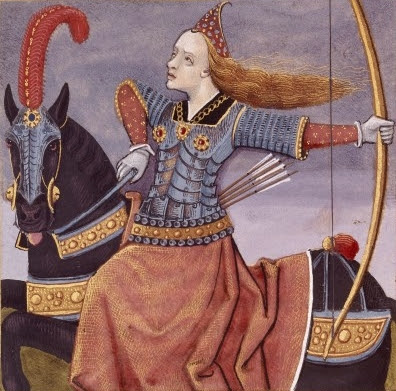
What I find surprising about this particular manuscript is how many women are pictured wearing armour. Take Tamyris for example:

Queen Tamyris became queen of her people in her own right after her husband died. The Persian emporer of the time, Cyrus the Great, decided he wanted her land and asked her to marry him. She refused and so there was war. There were a few more complications than that, in all honesty; after all, her son was captured and committed suicide in shame. That's going to make any mother angry, so when she and her army caught up to Cyrus, she had him killed, then beheaded and crucified, before putting his head into a wineskin filled with blood. After that, she had his brain scooped out and turned into a bowl for wine, just in case that wasn't enough retribution for the loss of her son and the deaths of those in her armies. To clarify, Tamyris is a historical person, just in case any of that seemed too fantastic.
Another warrior woman shown in armour in the manuscript is Penthesilea. Penthesilea was an Amazon queen who accidentally killed another Amazon queen whilst out hunting, so in order to be purified of the crime, she was sent to fight on the side of Troy in the Trojan War.
The other two women to be shown in armour in this manuscript are Orithyia and Antiope, who were both Amazon queens who co-ruled:

Antiope was the wife of Theseus and there are several variations on her tale, all ending in her death in a battle or fight. Orithyia, likewise, died of her wounds after beseigeing Athens in order to get her sister back. In a way, showing these four women in armour is not strange, as Tamrys and Penthesilea are two of the nine female worthies named by Eustache Deschamps -- individuals who personified the ideals of chivalry of the later part of the 15th century. From there it's easily argued that if you show one Amazon in armour, you have to show the rest in armour too.
The manuscript has so much to offer in terms of showing female attire of the 15th century though. For example you've a depiction of Clytemnestra, Agamemnon's wife looking quite well dressed:

...and Epicharis, a freedwoman from Nero's Rome, who refused to betray her fellow conspirators to assassination, despite being heavily tortured. She's shown in the manuscript with some very nice side lacing:

There are so many examples of good medieval female fashion in De Claris Mulieribus 599 that it's worth checking out the gallery on Wikimedia Commons. I do believe this manuscript is also worthy of a few posts!


What I find surprising about this particular manuscript is how many women are pictured wearing armour. Take Tamyris for example:

Queen Tamyris of the Massagetae, lead her army to victory against the Persians in 529BC. "I warned you that I would quench your thirst for blood, and so I shall". Wikimedia Commons.
Queen Tamyris became queen of her people in her own right after her husband died. The Persian emporer of the time, Cyrus the Great, decided he wanted her land and asked her to marry him. She refused and so there was war. There were a few more complications than that, in all honesty; after all, her son was captured and committed suicide in shame. That's going to make any mother angry, so when she and her army caught up to Cyrus, she had him killed, then beheaded and crucified, before putting his head into a wineskin filled with blood. After that, she had his brain scooped out and turned into a bowl for wine, just in case that wasn't enough retribution for the loss of her son and the deaths of those in her armies. To clarify, Tamyris is a historical person, just in case any of that seemed too fantastic.
Another warrior woman shown in armour in the manuscript is Penthesilea. Penthesilea was an Amazon queen who accidentally killed another Amazon queen whilst out hunting, so in order to be purified of the crime, she was sent to fight on the side of Troy in the Trojan War.

"Furious Penthesilea leads a battleline
of Amazons with crescent shields, and she glows in the middle
of thousands fastening golden belts around the exposed breast,
female warrior, and the maiden dares to run with men." From The Aenid. The picture does not show exposed breast, but it certainly hints at it. I also cannot help but wonder if it is inferred that there is armour plating under that skirt, but that's my personal speculation.
Penthesilea caught the attention of Achilles due to her prowess in battle and so he arranged matters to where he would face her on the battlefield. She fought him, but sadly, she was fighting Achilles. The story goes that as she died, Achilles saw her beauty, fell in love and actually mourned her.
The other two women to be shown in armour in this manuscript are Orithyia and Antiope, who were both Amazon queens who co-ruled:
Nice armour, ladies. Although I'd love to know how Antiope intends to sit down without stabbing herself somewhere entirely unpleasant.
Antiope was the wife of Theseus and there are several variations on her tale, all ending in her death in a battle or fight. Orithyia, likewise, died of her wounds after beseigeing Athens in order to get her sister back. In a way, showing these four women in armour is not strange, as Tamrys and Penthesilea are two of the nine female worthies named by Eustache Deschamps -- individuals who personified the ideals of chivalry of the later part of the 15th century. From there it's easily argued that if you show one Amazon in armour, you have to show the rest in armour too.
The manuscript has so much to offer in terms of showing female attire of the 15th century though. For example you've a depiction of Clytemnestra, Agamemnon's wife looking quite well dressed:
I bet that headdress makes her at least a foot and a half taller. However, you have to appreciate that neckline...
...and Epicharis, a freedwoman from Nero's Rome, who refused to betray her fellow conspirators to assassination, despite being heavily tortured. She's shown in the manuscript with some very nice side lacing:
In case you're wondering, she's said to have strangled herself on her girdle in order to prevent her confession under a second bout of torture...
There are so many examples of good medieval female fashion in De Claris Mulieribus 599 that it's worth checking out the gallery on Wikimedia Commons. I do believe this manuscript is also worthy of a few posts!


