Sunday, 18 November 2012

Boccaccio's Famous Women

I was doing more research into Chaucer's works when I stumbled upon Boccaccio.  Boccaccio wrote the Decameron, published around 1353, which is the work that inspired Chaucer's Canterbury Tales.  Boccaccio also wrote a work in 1374 called De Claris Mulieribus (Of Famous Women).  This book was unusual for it's time in that it was the first collection of solely female biographies ever written.  It includes 106 different biographies about famous historical or mythological women.  Of course, as this is a medieval work, there are several different copies of this manuscript.  On top of that, Boccaccio also decided that he'd like to revise his book a few times in the last 20 years of his life and send many of them to influential women.  As this was a very popular book, there were also versions printed after his death.  My favourite illustrations are from De Claris Mulieribus, 599, which is held by the National Library of France, which is dated as being 1401-1500, with no further information.  Sadly, their online copy is only available in black and white, which is rubbish because the illustrations in this particular manuscript are beautiful.  Hooray for Wikimedia Commons though, which has plenty of the illustrations in colour!

What I find surprising about this particular manuscript is how many women are pictured wearing armour.  Take Tamyris for example:

Queen Tamyris of the Massagetae, lead her army to victory against the Persians in 529BC.  "I warned you that I would quench your thirst for blood, and so I shall".  Wikimedia Commons.

Queen Tamyris became queen of her people in her own right after her husband died.  The Persian emporer of the time, Cyrus the Great, decided he wanted her land and asked her to marry him.  She refused and so there was war.  There were a few more complications than that, in all honesty; after all, her son was captured and committed suicide in shame.  That's going to make any mother angry, so when she and her army caught up to Cyrus, she had him killed, then beheaded and crucified, before putting his head into a wineskin filled with blood.  After that, she had his brain scooped out and turned into a bowl for wine, just in case that wasn't enough retribution for the loss of her son and the deaths of those in her armies. To clarify, Tamyris is a historical person, just in case any of that seemed too fantastic.

Another warrior woman shown in armour in the manuscript is Penthesilea.  Penthesilea was an Amazon queen who accidentally killed another Amazon queen whilst out hunting, so in order to be purified of the crime, she was sent to fight on the side of Troy in the Trojan War.
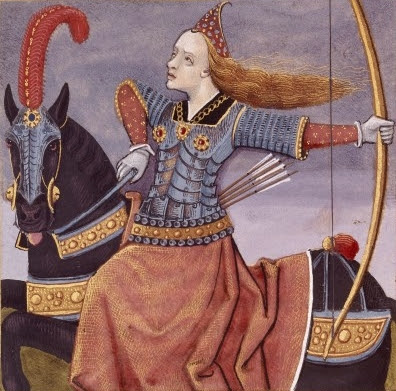
"Furious Penthesilea leads a battleline of Amazons with crescent shields, and she glows in the middle of thousands fastening golden belts around the exposed breast, female warrior, and the maiden dares to run with men."  From The Aenid.  The picture does not show exposed breast, but it certainly hints at it.  I also cannot help but wonder if it is inferred that there is armour plating under that skirt, but that's my personal speculation.

Penthesilea caught the attention of Achilles due to her prowess in battle and so he arranged matters to where he would face her on the battlefield.  She fought him, but sadly, she was fighting Achilles.  The story goes that as she died, Achilles saw her beauty, fell in love and actually mourned her.

The other two women to be shown in armour in this manuscript are Orithyia and Antiope, who were both Amazon queens who co-ruled:

Nice armour, ladies.  Although I'd love to know how Antiope intends to sit down without stabbing herself somewhere entirely unpleasant.

Antiope was the wife of Theseus and there are several variations on her tale, all ending in her death in a battle or fight.  Orithyia, likewise, died of her wounds after beseigeing Athens in order to get her sister back.  In a way, showing these four women in armour is not strange, as Tamrys and Penthesilea are two of the nine female worthies named by Eustache Deschamps -- individuals who personified the ideals of chivalry of the later part of the 15th century.  From there it's easily argued that if you show one Amazon in armour, you have to show the rest in armour too.

The manuscript has so much to offer in terms of showing female attire of the 15th century though.  For example you've a depiction of Clytemnestra, Agamemnon's wife looking quite well dressed:

 I bet that headdress makes her at least a foot and a half taller.  However, you have to appreciate that neckline...

...and Epicharis, a freedwoman from Nero's Rome, who refused to betray her fellow conspirators to assassination, despite being heavily tortured.  She's shown in the manuscript with some very nice side lacing:

In case you're wondering, she's said to have strangled herself on her girdle in order to prevent her confession under a second bout of torture...

There are so many examples of good medieval female fashion in De Claris Mulieribus 599 that it's worth checking out the gallery on Wikimedia Commons.  I do believe this manuscript is also worthy of a few posts!

Follow Me on Pinterest

Tuesday, 13 November 2012

Henry VIII: The Prince in Mourning

When you think of Henry VIII, you think of a rather large ginger man who ate too much and always got his way.  The church disagreed with him, so he left and created his own damn church; he went through wives at a rate of knots; he was absolute ruler and commanded obedience in court.  He pulled no punches and seemed pretty heartless, but he also came across as a strong, charismatic leader, showing anger rather than sadness or vulnerability.

 Henry VIII.  Ladies... check out my cod.  WOOF!
Portrait from 1540 by Hans Holbein.

People forget that the man was once a child whose mother died when he was 11.  It had been a hard time for the family; his brother, Arthur, died of some kind of fever-based illness in April 1502.  Elizabeth, his mother, fell pregnant and gave birth to a girl called Catherine on the 2nd February, 1503, but the child died a few days later.  Elizabeth then died to a post partum infection a week after the child died.  You cannot help but empathise with the small child shown in this manuscript:

 Prince Henry weeping at his mother's empty death bed.  The two girls are his sisters shown in mourning attire, Princess Margaret (aged 13) and Princess Mary (aged 7).  Poor kids.

Henry was known to be very close to his mother so it's no surprise that the young prince was devastated.  It's possible that his distanced relationship with his father was compounded by his mother's death, as according to one account, his father "privily departed to a solitary place and would no man should resort unto him".  Harsh.  Sometimes a kid needs his dad, even in 1503.

This image has had a lot of interest lately; although the Vaux Passional has been in the National Library of Wales since 1921, it's recently been digitised and therefore re-evaluated.  No one had really looked at it in a while.  People are interested in this image because Henry VIII has never been pictured as being vulnerable or even having grieved for anyone much, even as a child.  During the re-evaluation, it became evident that this Passional was likely part of the library of Henry VIII's father, Henry VII.  In fact, it's possible that the image below actually shows the Vaux Passional being given to Henry VII:

Illumination showing the possible presentation of the book to the king.  Prince Henry is weeping in the background.

The activity in the background has actually helped to date the piece somewhat, placing its creation at the start of the 16th century.  The manuscript, which is written in French, similarly follows themes of death.  It contains two bodies of work -- a Passional and Le Miroir de la Mort by Georges Chastellain.  The Passional calls on the reader to meditate on the arrest, trial, Crucifixion and Resurrection of Christ.  It starts at the raising of Lazarus and ends with Judas and Pontius Pilate.  Le Miroir de la Mort is a work that discusses "the futility of wordly pleasures in the face of certain death".  Cheery stuff then.

 Illumination from the Vaux Passional showing "Christ between two thieves".  The source has stunning detail, available here)

The manuscript also shows the seige and fall of Jerusalem, which I think is my favourite illumination -- saving for that of Prince Henry:


It's worth taking a look through the National Library of Wales online gallery for this book.  It's all stunning, and all done by one person who lived in London back in the early 1500s.  No one knows who made it, but it's pretty clear they had a good understanding of death and sadness.  It's also a wonderful reminder that this "swaggering warrior king" was once a child.
Follow Me on Pinterest

Wednesday, 7 November 2012

How to Verify your Blogger Blog on Pinterest

I normally keep to writing about history stuff, but this is a pretty useful tip, so I thought I'd share it.  Last week I found this "verify website" checkmark on my Pinterest profile page.  It's a new feature designed to make it easier for users to find out more about who they're following, and a way for profile owners to highlight their website on their profile.  Note that they're still rolling out the verify feature, so if you don't see this feature anywhere on your Pinterest, it may not be with you yet.  Pinterest is currently only supporting this feature on top level domains right now, but bloggers are finding work arounds in order to get their sites verified.  I've yet to find a blogger work around other than this one, and this one took some experimentation. 

The problem lies in not being able to just upload an HTML page, which is what Pinterest wants you to do in order to get verified.  But here's a workaround for that...

How to Verify your Blogger Site for Pinterest 

1.  Login to your Pinterest account and go to settings.
2.  Click on the "Verify Website" check mark next to your website address.
3.  The instructions below will appear.  Download the HTML verification file (mine was called pinterest-987a1.html):


4.  Log into your blogger account, go to your blog dashboard, and go to pages.  Make sure that your "show pages" option (highlighted in red below) is set to "don't show":

 
This stops your Pinterest verification document from being linked on your site -- unless you specifically link it for whatever reason.

5.  Click on the "New Pages" button.  You should see the following pop-up menu:


6.  Select the Blank page option.   You will be taken to what looks like a new blog post.  I changed my view from compose to HTML at this point.

7.  Open up your downloaded Pinterest file in Notepad.  If you're on a mac, open it in TextEdit (Mac Users Note:  If you open your file in TextEdit and you see images instead of code, close the file and go to TextEdit > Preferences > Open and Save and check "Ignore rich text commands in HTML files".  Then reopen your file).

8.  Hopefully, you should see the code.  Select all of the code and copy it.

9.  Paste all the code into the "body" of your new page.  Name your page as per the HTML file you downloaded (see below):


10.  Save the page and publish it.  If it doesn't take you back to Pages once you've published this page, go to Pages and select "view" under your Pinterest html page.  It will take you to the Pinterest verification page as it should be viewed in your browser.  Don't head over to Pinterest just yet!

11. Go to where your browser shows your website link.  Only select the part highlighted below and include the slash:


In short, my website's main page is http://interestingpretties.blogspot.co.uk.  The part that is highlighted above is the link to the page you've just created.  But you only need the tail end for what we're about to do, because Blogger assumes that you're working within your blog domain and auto-fills that part for you.

12.  Go to settings > search preferences > errors and redirections > custom redirects > edit.

13.  Paste this fragment of URL into the "To" box.  In the "From" box, type the name of the Pinterest generated HTML document, including a slash (so /pinterest-987a1.html in my example).  Check the "Permanent" box below and hit save.  It should all look like this:


14.  Go back to the Pinterest page that started you on this jaunt.  You can either go to Pinterest and then settings, or you can view the page you created and click on the "Go to Pinterest" link.  You may need to click on "3.  Click here to complete the process."


It'll think about it for a moment and then you should be verified.  Winner!

Edit:  It's come to my attention that I wasn't the first person to find this method out.  Pravin Vibute at http://www.toptrix.net/2012/11/verify-blogger-blog-pinterest-profile-without-html-file.html discovered it four days earlier.  Good man!


Follow Me on Pinterest


Tuesday, 6 November 2012

Fawkes: He's just this Guy, y'know...

Yeah, I know.  It's the day after Guy Fawkes night, but I have a good reason for posting late:  We were watching stuff explode.

When I lived in the states, I remember patiently explaining that no, we did not celebrate July 4th in England.  Why would we have a "we lost" or "good riddance" day?  But the idea of Bonfire Night, 5th November and Guy Fawkes would draw a look of confusion onto the faces of a lot of folks.  The explanation I used to give ran like this:

Back in 1605, a group of Catholic conspirators decided they wanted to put a Catholic on the throne because they'd had a lot of religious persecution over the years.  So these conspirators decided to blow up Parliament with King James I inside.  One of the conspirators decided he should probably warn his brother-in-law to avoid parliament on 5th November, which led to Guy Fawkes being caught in Parliament's basement with 36 barrels of gunpowder.  So ever since then, the British set off fireworks and burn effigies of Guy Fawkes as a celebration of a plot that failed to kill a king.  [Cue the massive look of confusion].  No, we're not really sure what we're celebrating any more, but everyone likes an excuse to set things on fire and to watch fireworks.  [Cue a sudden light of understanding].

Woodcut of the conspirators, created by Crispijn Van de Passe around 1605.  Fawkes is third from the right.  The chap named Bates on the left was a servant and therefore not important enough to have his first name featured -- everyone else was of a higher class.  Only eight of the thirteen are pictured.  From Wikimedia Commons.

That is pretty much the bare facts of the matter, stripped of history, culture, context and additional information.  Sure, these chaps had very much been subject to persecution -- under Elizabeth I.

 Elizabeth I:  Not nice to Catholics.  Rainbow portrait, ca. 1600, meant to show her agelessness.  

She had passed several laws that saw people executed for their beliefs, often through being hung, drawn and quartered.  James I was her successor and wanted to be more tolerant, stating that he would not persecute Catholics "that will be quiet and give an outward obedience to the law." 

 James I:  Wanted to be nicer to Catholics, considering his mum was one.  Sadly, they tried to blow him and his wife up.  That kind of thing makes a monarch angry.  Ca. 1603-1609.

However, James I did not openly remove any sanctions either -- after all, at the time of the gunpowder plot he was on the throne barely two years.  The plot did nothing to encourage him to be nice to Catholics either.

Guy Fawkes was captured red-handed and held as his majesty's convenience in the Tower of London.  Fawkes was held at some length in a cell called "Little Ease", which was a cell only 4ft long by 4ft high, and only as deep as the wall.  The idea was that it was too small to lie down, stand or sit comfortably.  Of course, that was the least of what happened to Guido Fawkes.  He refused to give his name (John Johnson being the worst false name ever) and his co-conspirators fled, with several dying in a last-stand siege.  After 10 weeks of torture, Guido Fawkes finally signed confessions -- one is so faint and shaky it's just grim, and the other is marginally better, signed eight days later:

 This is your signature on 17th Century Torture:  The signature on the first confession (above) lies below the word "good".  Wikimedia commons.  

This is your signature 8 days after 17th Century Torture:  Still shaky.  Still grim.  Guy Fawkes' signature on the second confession.  National Archives.

All the conspirators faced ugly ends -- those who died before being executed still had their corpses decapitated and placed on Traitor's Gate.  Those who survived the seige got the worst of it; they were hung until nearly dead and then whilst still conscious they were castrated, disemboweled and then quartered.  Ironically, Guy Fawkes had the cleanest death of the lot.  He'd decided that he'd suffered enough, thank you, and so jumped from the scaffold to hang, breaking his neck and cheating the executioner.

The British, being the cheerful people that we are, decided that we would turn all this into a celebration.  Burning effigies of Guy Fawkes became commonplace, and although it's not so common now, I remember as a child seeing other kids making Guys and asking adults for "a penny for the guy" so they could go off and buy fireworks. Thanks to these effigies, the word "guy" also came to mean an oddly dressed man, before becoming used as it is today.

It's got to be said though, as a child, I remember some fantastic Guy Fawkes Nights.  When you're six, all you remember are the fireworks and the poem...

"Remember, remember, the 5th of November,
Gunpowder, treason and plot.
I see no reason why gunpowder treason
Should ever be forgot."

...with the meaning totally lost on you.  But it doesn't matter because you are six, there are fireworks and fireworks are amazing!
Follow Me on Pinterest

Monday, 29 October 2012

Freydís Eiríksdóttir, Viking Warrior

A recent study of Viking burials in Britain showed that there were a lot more female Vikings in invasion forces than scholars have given credit for over the years.  In fact, it's now estimated that the invading forces to Britain may have been between 33-50% female.  The reason for this change of heart is that archeologists have started analysing the skeletons found in burials, as well as the grave goods, rather than judging gender on the grave goods only.  In the past, a burial with a brooch was thought to be female; with a sword, it was thought to be male; with both, it was a male burial with a female offering.  The new study shows that no, those were women with swords and brooches -- after all, what Viking warrior woman would go to settle somewhere without her sword and her jewelry?

Sure, that sounds like jest, but I find it hardly surprising in a lot of ways.  I know I can fight with a sword and shield; I also know that there's no way I'd want my other half to go off to colonise another country without me.  And dammit, I'd want my brooches and my sword, especially if the brooches were being used to hold my clothes on.  Which they were:

10th Century Woman's Oval Brooches found in Suffolk, England.  British Museum.  Viking Bling!

Revival clothing -- brooches in place!  (Link:  http://www.revivalclothing.com/10th-11thcearlymedievalvikingaprondress.aspx )

So, back to Freydís Eiríksdóttir, one of a potentially more prevalent breed.  She was the daughter of Eric the Red and one of those colonists to go to Vinland -- that part of Canada that her brother, Lief Eiríksson, discovered.

She went out there in the early 11th Century with her husband.  The natives, called Skraelings in the Sagas, seemed to be interested in trade at first.  The Skraelings tolerated the Viking squatters and traded animal furs for strips of red fabric as the natives had no method of creating red fabric dyes at that time.  As the Viking settlers ran out of cloth, the natives still wanted to trade, but the Vikings had nothing left -- except cow's milk.

Cue the cultural misunderstanding that is lactose intolerance.  The Skraelings believed they'd been poisoned and this soured relations between the people for several years.  This became compounded by a bull escaping and roaring around the locality before the Vikings could get it back into it's pen.  The Skraelings ran, terrified by the monster and weren't seen for three weeks, when they returned in force.

 Although I'm fairly certain they didn't know about lactose intolerance during this time period, the saga of Erik the Red was written down between 1387 - 1394.  This is what it looks like -- The Flateyjarbók (The Flatley Book).

They rowed up the river, outnumbering the Vikings, brandishing their staves and howling.  The Vikings stood their ground.  They bared shields on the shoreline and prepared for battle.  However, the Skraelings had slings and pole weapons that flung projectiles that caused terrible damage and made terrifying noises when they struck the shore.  The Vikings had no reach; they were outnumbered and were fighting a battle on all sides.  They did the only sensible thing -- they tried to use geography.  They retreated, pulling the battle into "certain crags", creating a bottleneck and forcing fighting from only one or two positions and reducing enemy contact, despite being outnumbered.

Sadly, Freydís Eiríksdóttir was in the camp and heavily pregnant.  She couldn't keep up with the retreat.  As she saw the way the battle was retreating, she called out:

"Why run you away from such worthless creatures, stout men that ye are, when, as seems to me likely, you might slaughter them like so many cattle? Let me but have a weapon, I think I could fight better than any of you."  (Saga of Erik the Red)

She was left behind, so she tried to catch up to them through the woods.  All she found was the body of a fellow Viking, Thorbrand, with a stone lodged in his skull... but he'd been carrying a sword.  She grabbed the sword, stopped running and prepared to defend herself.  As the Skraelings came upon her, she let out a battle cry, bared her breast and struck it with the flat of the sword.  The Skraelings fled, likely terrified of the fierce, definitely female and definitely pregnant being in front of them.  I can't say I blame them as an armed, angry, topless pregnant Viking woman fighting for survival would be a truly terrifying opponent.

Freydís Eiríksdóttir:  Officially a better fighter than any of the chaps in the above picture from The Flatley Book.  Even though they weren't even in the same saga.

The Viking men came back after the Skraelings fled, praising her for her battle zeal, though I'm fairly sure she was thinking "what choice did I have?".  Two Vikings and four Skraelings died in the battle, which were certainly not the last deaths on either side.

After this point, Freydís was known for a level of bravery -- until more expeditions went out.  The second expedition had two boats, with one of them sinking in bad weather.  There was no loss of life; however, that meant there were two crews on one ship and half the provisions.  In a fit of cold logic, she ordered everyone on the first ship to kill everyone who'd been on the second.  They complied, but the men refused to kill unarmed women.  Of course, Freydís had no problem with that and cut the heads off the five women on the second boat.  Grim.  They reached land.  They fought the natives.  They left again.  The sagas do not state whether or not anyone starved to death; for that kind of sacrifice, you have to hope not.

She then led a third expedition herself, partnering up with two brothers and her husband.  She was pretty manipulative and made sure she and her husband got the bigger boat, as well as hiding five more men on her boat than she'd agreed with the brothers.  The brothers fell out with her to the point that two camps were formed once they'd reached Vinland.  She then swore that the brothers assaulted her, so the men of her camp attacked and killed everyone in the other camp, except, again, the men refused to kill unarmed women.  She and her axe saw to it that the women were killed.  She then bade that no one tell of what happened on their return home.

She allegedly lived to an old age, dying of natural causes; a rich outcast, but an outcast, nevertheless.  Now, I'm aware that this saga wasn't written with all the facts of each situation.  I'm aware that winners write the histories and the outcasts are never the winners.  I still can't help but hope that bad press is the major source for the last two paragraphs, but I doubt it is.  Why couldn't she stay the badass Viking warrior that took on the Skraelings whilst she was pregnant?   Then again, badass Viking warriors are rarely known for their mercy...

References:
More Female Viking Invaders Than Previously Thought Sources here.
And here.
Follow Me on Pinterest

Friday, 26 October 2012

Canterbury Tales

I had one of the pages from Chaucer's Canterbury Tales appear in my feed, so it's compelled me to go off and do more research as the artwork is truly stunning.  It's odd; I remember being in class reading through it all in 11th Grade AP English, being actually quite bored by it, but I think that part of the problem was that we were focusing solely on the stories, not the art or the social importance of the piece.  I'm a bit sad that I decided that "Mr. Cliff and his notes" would be an awesome shortcut, but then again, what do you know when you're 16, you're in High School, and your love of your life has just broken up with you after three months?  How times change...

Anyhow, here are some awesome pictures I've dug up from various places online.  The first page of the tales is quite gorgeous and actually, very readable given it's in archaic English:

"Ere begynneth the book of tales of Canterburye compiled by Geffraie Chaucer of Brytayne chef poete"

Although Chaucer wrote his tales between 1387 and 1400, this is a copy of his tales made around 1450.  Sadly, according to the British Library, no copies exist today that Chaucer wrote himself.  However, the fact that at least 80 copies from the 15th century do still exist points to his works being incredibly popular.

They were popular for many reasons.  Firstly, he wrote about a cross-section of society from dyers to nuns and it was a work of social commentary, which always grabs attention.  He also chose to write the stories in English, which was pretty rare in England at that time.  The ruling classes spoke French seeing as the Normans had invaded a few centuries before, with the normal, everyday classes speaking English.  This is probably another reason it was popular -- it was actually the language many people spoke.

A picture of Chaucer as a pilgrim from the Ellesmere Manuscript.  "Heere Bigynneth Chaucers Tale of Melibee" 

That's not to say that people were particularly literate, but that is to say that English was a popular spoken language in England (who'd've thought it?).  As this was one of the first times that the English language had been written down for this purpose post-invasion, Chaucer also got a chance to sculpt it and capture it, showing that different classes spoke in different manners.  What I really like though is the portraits of some of the people telling the tales.  The Prioress, for example is really quite a beautiful illumination:


I also like the Ellesmere version of the Man of Law, however it's smudged now, sadly:


I still find it beautiful.  I think I'm going to end up doing a few posts about this one...


Follow Me on Pinterest

Thursday, 25 October 2012

De Arte Venandi Cum Avibus

Sometimes you see something interesting that leads you down a path of research that you didn't intend.  This totally happened today and I ended up googling De Arte Venandi Cum Avibus (On The Art of Hunting with Birds), a medieval treatise on ornithology and falconry.  Written in the 1240s by Frederick II of Sicily, it now exists in two forms as the original was lost in 1248 during the siege of Parma.  One form is a six-book version, the other is a two book version, which is an illuminated manuscript.

And it is gorgeous:


Sure, that's not necessarily one of the more spectacular illuminations in terms of medieval bling, but what I'm taken by is the sheer simplicity as well as the really nice layout.  That is a work of talent.  It also shows some of the hawking pouches that I make, which is nice too.

The book itself contains around 500 illustrations of about 80 different species of bird, some in flight:


Some being attended by falconers:


Some in the middle of eating the ears off a rabbit:


(Thank you, Wikipedia!)

Frederick wrote this book with the intention of sharing some of his scientific knowledge in terms of breeding and handling.  He did experimentation with eggs and how they hatched.  He also wrote "Whoever wants to learn the art of hunting with birds to be able to feed them, keep them, tame them, take them, teach them to hunt other birds sent them to hunt and, if necessary, treat, must unite, the quality which will be indicated, science (the theoretical and practical knowledge) contained in this work."  He was a big believer in doing things right.

I've not been able to find any single place online that holds all the illustrations, nor anywhere that holds a translation, sadly.  However, there is a Latin copy of just the text here:  http://www.scribd.com/doc/20486846/De-Arte-Venandi-Cum-Avibus-1, although my basic High School Latin fails after a sentence and a half, sadly.  Still, if anyone would like to spend out on a translated copy, there's one available on Amazon with the original pictures too.  It's 768 pages long and quite some money:


I know it's expensive, but I'm still not convinced that it's not worth it.  I should probably go have a word with myself about that...  
Follow Me on Pinterest